Drancy internment camp
The Most Precious of CargoesDrancy internment camp is both a place of enforced confinement and a brief, precarious interval in a family’s history: Henri, Rose, their parents, and other Jewish internees remain together there before deportation. The novel places camp life between the family’s earlier separation from others at Pithiviers and the cattle wagon that carries them away, showing how a fragile period of routine and hope is overtaken by hunger, fear, and the machinery of deportation.
Confinement and the family’s reprieve
The family reaches Drancy after being transported from Pithiviers. On the journey between the two camps, they have so far avoided separation, while other internees have been taken away one after another. The father believes the twins, Henri and Rose, have helped keep the family together. Their birth in the spring of 1942 comes at a moment he considers perilous: they are Jewish children born under the yellow star. Yet the twins’ presence also gives the parents a reason to hope that they might spend Christmas together in Drancy. That reprieve is real, but limited; the family’s continued unity depends on circumstances they cannot control.
Drancy’s population and its administration shape what work the father can do. He has nearly completed medical studies, specializing in eye, ear, nose, and throat surgery, but is told that the camp already has many doctors and patients. When two camp hairdressers leave, he takes up barbering instead. The work is a sharp departure from his training, yet he performs it convincingly: his experience watching his father cut hair has taught him the motions, and even trained barbers take him for one of their own. The camp’s shortages and institutional arrangements thus redirect a nearly qualified doctor into a trade that can serve internees.
A life organized by changing guards
For as long as French gendarmes guard the internees, the father cuts hair. After they are replaced by the verts-de-gris, his clientele contracts to members of the administration and a few desperate internees. The change in guards alters the conditions of ordinary work: he must repeatedly reassure customers, though he has no power to promise that everything will be all right. Barbering remains a small routine within confinement, but its shrinking reach registers the camp’s worsening atmosphere and the limits of reassurance under coercion.
The family’s earlier experience of childbirth stands in painful contrast to the journey from Drancy. At the tiny maternity clinic on rue de Chabrol, the parents had been offered the possibility of placing the children with a family considered trustworthy. Dinah refuses that separation, insisting that the children’s own parents are the family they can trust. She has enough milk to feed the twins and meets their arrival with love and confidence. By the time the family is carried away from Drancy, however, deprivation has dried up her milk, confidence, and hope. The camp is not presented as the twins’ birthplace; rather, it is where the security and bodily resources that had sustained their mother are exhausted.
From internment to deportation
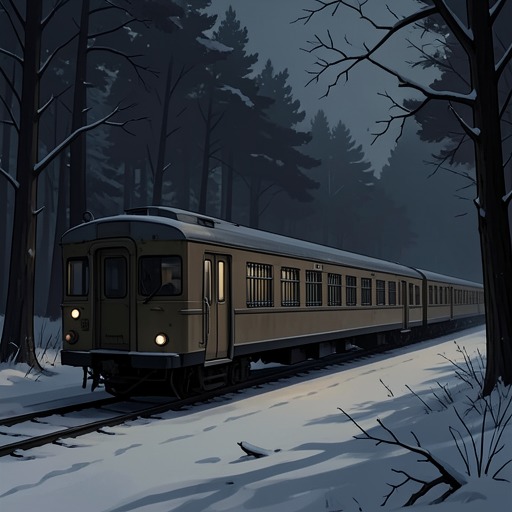
The father’s next view of Drancy is from a cattle wagon, its floor covered in straw. On the train, Dinah lies with the children on a woolen Pyrenean shawl, unable to feed them adequately. Their parents are already gone, and there has been no word from them; the father also remembers the later departure of his own father. Around the family are old people, a blind man, children, and other internees. Looking at them, he understands that the journey is not taking them to work: they are being sent away because they are no longer wanted in France. Drancy’s role in the narrative is therefore not only to confine the family but to stand at the threshold of forced removal.
The train designated Convoy 49 left Bobigny-Gare, near Drancy, on March 2, 1943, carrying 1,000 Jews. Among them were Zacharie Grumberg, identified in the appendix as the author’s father, and Sylvia Menkès, born on March 4, 1942, and killed by gassing on March 4, 1943, her first birthday. Convoy 49 arrived on March 6 at its final destination, which the narrative describes as a pit of hell. These details establish the historical scale and stakes of the departure without confusing the camp with the train’s destination: Drancy is the place of internment from which deportation proceeds, while the convoy carries its passengers onward.
The camp’s place in the narrative and record
Drancy concentrates several stages of persecution into one setting: the family’s temporary preservation, the father’s improvised work, the erosion of Dinah’s ability to nurse, and the realization that confinement will lead to deportation. The change from French gendarmes to the verts-de-gris, and from a barber’s broad clientele to a few frightened customers, makes the deterioration legible through daily life as well as through the family’s forced departure. The camp’s routines cannot make the family safe; at most, they furnish a short interval in which its members remain together.
The appendix also places individual departures within a documentary history. It records Convoy 45 leaving Drancy on November 11, 1942, with 778 men, women, and children, and notes that only two survived in 1945. For Convoy 49 it supplies a departure date, a total of 1,000 deportees, and names that bind the fictional family’s world to historical records. The Memorial to the Deportation of Jews from France, compiled by Serge Klarsfeld in 1978, is described as serving many children of deportees as a family vault. In this frame, Drancy is at once a location in the narrative and a point in a documented chain of internment and deportation: a place where family life continues for a time, and from which names and people are carried into the record of loss.